
The Earth is an intricately coupled system, and simulating its behavior (from volcanic eruptions to global climate shifts) requires immense computational brute force. For decades, computers have been the quiet backbone of geosciences. Today, however, we stand at a major inflection point. High-Performance Computing (HPC) is pushing the boundaries of high-resolution simulations, while emerging technologies like Artificial Intelligence (AI) and Quantum Computing (QC) are completely fundamentally reshaping how we model, analyze, and predict our planet’s future.
This upcoming Geoscience Instrumentation and Data Systems (GI) Campfire session explores this dynamic frontier. Instead of looking at these technologies in isolation, we will explore how they build upon each other: how we currently harness supercomputing to solve critical environmental challenges, how AI is changing our modeling approaches, and how we are laying the groundwork for a hybrid classical-quantum future.
Guiding us through this computational evolution are two experts working at the cutting edge of Earth system modeling: Dr. Manuel Stocchi, Junior Associate Scientist at the Euro-Mediterranean Centre on Climate Change (CMCC) Foundation, and Dr. Mierk Schwabe, Interim Head of Department at the German Aerospace Center (DLR) Institute of Atmospheric Physics.
The Heavy Lifter: High-Performance Computing
To understand the sheer scale of modern geocomputing, we first look at HPC. Manuel Stocchi began his career applying HPC to volcanology, running extensive simulations of tephra dispersion from Neapolitan volcanoes to generate long-term hazard maps for Southern Italy. Today at CMCC, fueled by “unhealthy amounts of coffee and loud music”, he applies this computational power to climate sciences.
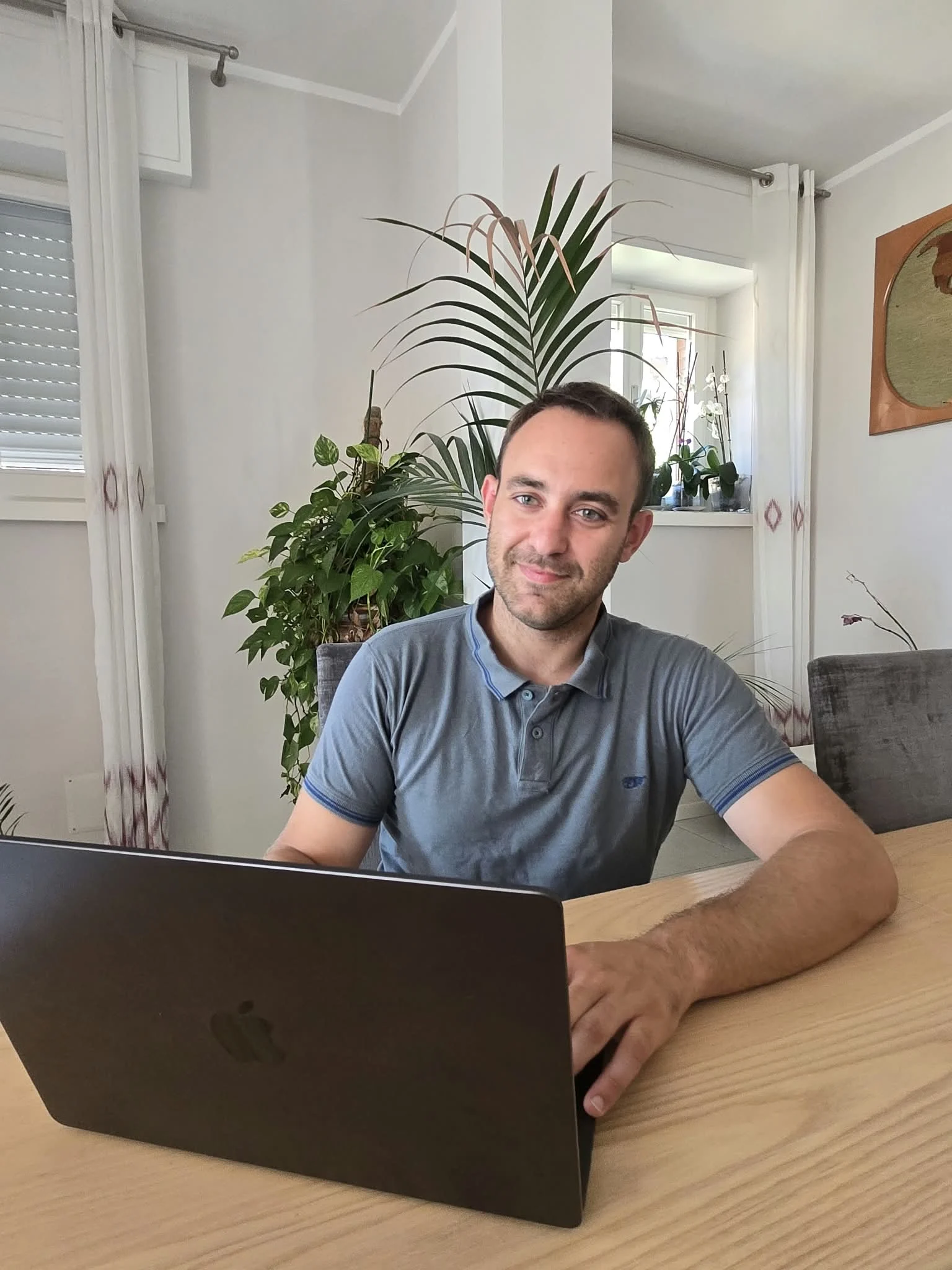
Manuel Stocchi
When evaluating what HPC has made possible compared to standard computing, Manuel points to massive international initiatives like CMIP6 (Coupled Model Intercomparison Project Phase 6). These initiatives provide the foundational climate projections used by the Intergovernmental Panel on Climate Change (IPCC). Running just one of these highly complex climate models would take years on a standard desktop computer; HPC architectures compress that timeline into a realistic, actionable window.
The Catalyst: Artificial Intelligence and Differentiable Modeling
While HPC expands what we can simulate, AI is revolutionizing how we build those simulations. Manuel emphasizes that AI and HPC are not separate tracks; they are evolving together in deeply integrated ways.
On the development side, AI coding assistants are increasingly helping researchers write and optimize complex parallel codes across a wide variety of programming languages, making the field more inclusive and efficient by moving beyond a strict reliance on legacy languages like Fortran. On the hardware side, future HPC systems will feature AI-specific optimizations that require smart architectural strategies from the geoscience community.
Scientifically, this convergence is creating powerful new tools: hybrid models that combine physical numerical solvers with machine learning (ML), fast ML emulators that replace computationally expensive processes, and “differentiable models” that leverage ML libraries (like PyTorch and Jax) for rapid inversion and minimization tasks.
The Next Frontier: Quantum Computing
If HPC is the present engine and AI is the catalyst, Quantum Computing is the uncharted horizon. Dr. Mierk Schwabe, whose career has spanned from experimental plasma physics on the International Space Station to climate modeling, now leads efforts to integrate quantum computing into Earth System Models at DLR.
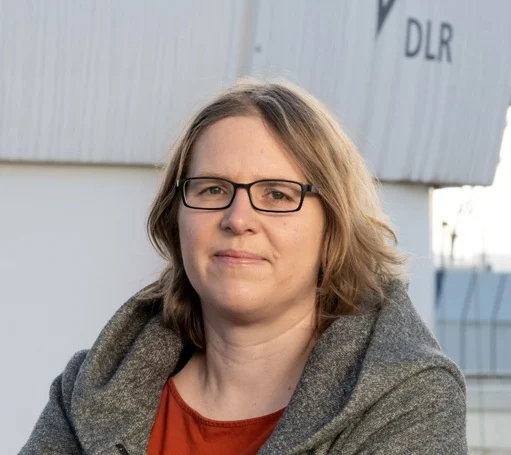
Mierk Schwabe
Dr. Schwabe is careful to set realistic expectations: Quantum Computing is still in an early exploration stage, and at present, quantum computers do not offer operational advantages over mature HPC systems. However, proactive research is absolutely crucial today so that the climate modeling community is ready to leverage these advances the moment hardware matures.
She notes that AI and QC will develop in a mutually reinforcing manner. Quantum machine learning will introduce unique properties of quantum circuits into AI workflows, while classical AI methods will help solve quantum bottlenecks through improved data encoding, circuit design, and training strategies to overcome challenges like noisy intermediate-scale devices and barren plateaus.
Looking Ten Years Ahead
When asked to look a decade into the future, both experts see a seamlessly integrated computational ecosystem.
Manuel envisions mature, high-resolution digital twins of the Earth system capable of continuously integrating real-time observations to simulate coupled environmental processes. Mierk foresees the hardware that will make this possible: coupled HPC-quantum systems featuring logical qubits, where quantum processors act as highly specialized components coupled to classical climate models running on massive HPC infrastructures. Once fault-tolerant quantum hardware matures, quantum partial differential equation (PDE) solvers could significantly accelerate the dynamical cores of these Earth system models.
The future of geosciences is hybrid, and preparing for it starts now.
Event Details
When: Wednesday, 14 October 2026 – 16:00 CET.
Where: Online Zoom, registration is required at https://lnkd.in/eEphHMRw
Who: Open to everyone.