Doing a PhD is a challenge in itself. Doing it in another country, away from family and friends, is even harder. Handling the requirements of academia while adjusting to a new culture, language, and way of life can be overwhelming at times. But, doing a PhD abroad is not defined by challenges alone. A new academic and social environment can lead to new friendships, fresh perspectives, and personal growth. What once felt foreign can start to feel like a second home. The experience of doing a PhD abroad reaches far beyond research, and will teach you many other things, like independence and resilience.
To give you some insights into what it means, and what it’s really like, to do a PhD abroad, we interviewed PhD students from around the world. The interviews are a part of our ongoing series “Expanding the picture – What does a geodesist look like?”, a collection of conversations that aims to highlight the diverse backgrounds, experiences, and career journeys of geodesists from around the world. Our first interview on the topic “PhD abroad” is with Shuxian Liu, who is from China and is currently doing a PhD in Germany. Curious about her experiences? Keep reading to find out.
Hi Shuxian, thank you for sharing your story with us and the geodesy community! Let’s begin with your academic path and research focus. Could you briefly introduce yourself and your PhD research, and explain how you usually describe your work to people outside academia? Additionally, what led you to pursue your PhD abroad and choose your current institution?
I am currently a third-year PhD researcher at Chair of Astronomical and Physical Geodesy at Technical University of Munich (TUM). My research focuses on quantifying land glacier mass loss and studying hydrological changes using satellite gravimetry and other Earth observation datasets such as GNSS. I also work with GRACE and GRACE‑FO data, including downscaling techniques and assimilation into hydrological models.
When explaining my research to non‑scientists, I describe it simply as “Earth science” and use relatable examples, like estimating glacier melt in the Alps or detecting how irrigation affects water storage. This helps make the topic understandable to people outside academia.
My decision to pursue a PhD abroad grew naturally from my academic journey. After completing a bachelor’s degree in Geodesy and Geomatics Engineering in China, I moved abroad for a Master’s program and found the research environment inspiring. Positive interactions with supervisors and colleagues during my Master’s led me to stay for the PhD.
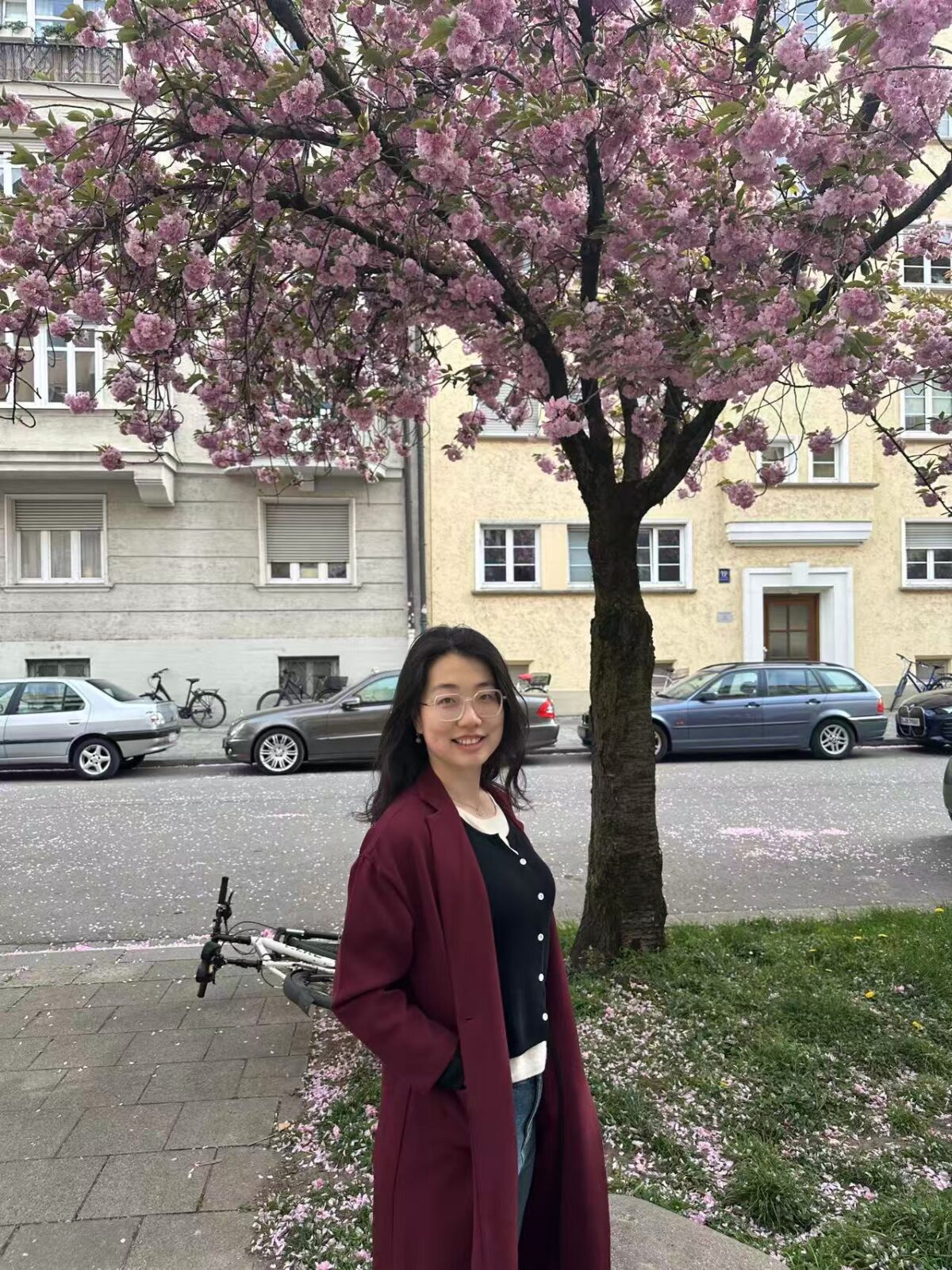
Picture of Shuxian Liu in Germany. Picture courtesy by Shuxian Liu.
Now let’s move on to your experience of living and studying in Germany. What were your first impressions of moving abroad, both academically and personally? What aspects of studying abroad have been most rewarding for you, and what cultural or academic differences stood out to you?
Arriving abroad during the COVID‑19 lockdown made the early transition difficult and isolating. Yet, academically, the shift was positive, the PhD program offered much more independence and freedom to explore research topics at my own pace.
Living abroad has been rewarding on many levels: learning a new language, becoming more independent in daily life, and establishing a balanced approach to work and personal time. These experiences have been essential for personal growth.
I also observed meaningful cultural differences. In my current academic environment, PhD students are encouraged to work independently and engage in critical discussion, while system in China tend to provide more structured supervision. Time-management cultures also differ scheduling everything in advance versus relying on more flexible, spontaneous planning. Experiencing both has made me more adaptable and open-minded.
Next, I would like to talk about challenges and personal growth during your PhD. What have been the main academic, administrative, or personal challenges of doing a PhD abroad, and how have you managed them? How has working in an international research environment influenced you and which skills have you developed the most?
Administrative tasks, especially visa, health insurance, and university paperwork, were among the biggest challenges. The need for early appointments, strict timelines, and dispersed information made the process stressful at times. Preparing documentation well in advance and seeking help from staff and colleagues helped reduce frustration.
Working in an international research environment broadened my academic and personal perspective. Interacting with people from diverse backgrounds encouraged me to consider new viewpoints, communicate more openly, and understand different working styles.
I have developed a wide range of skills during my PhD such as programming, scientific communication, and writing, as well as organizational and time‑management abilities. On the personal side, honestly, cooking has probably improved the most.
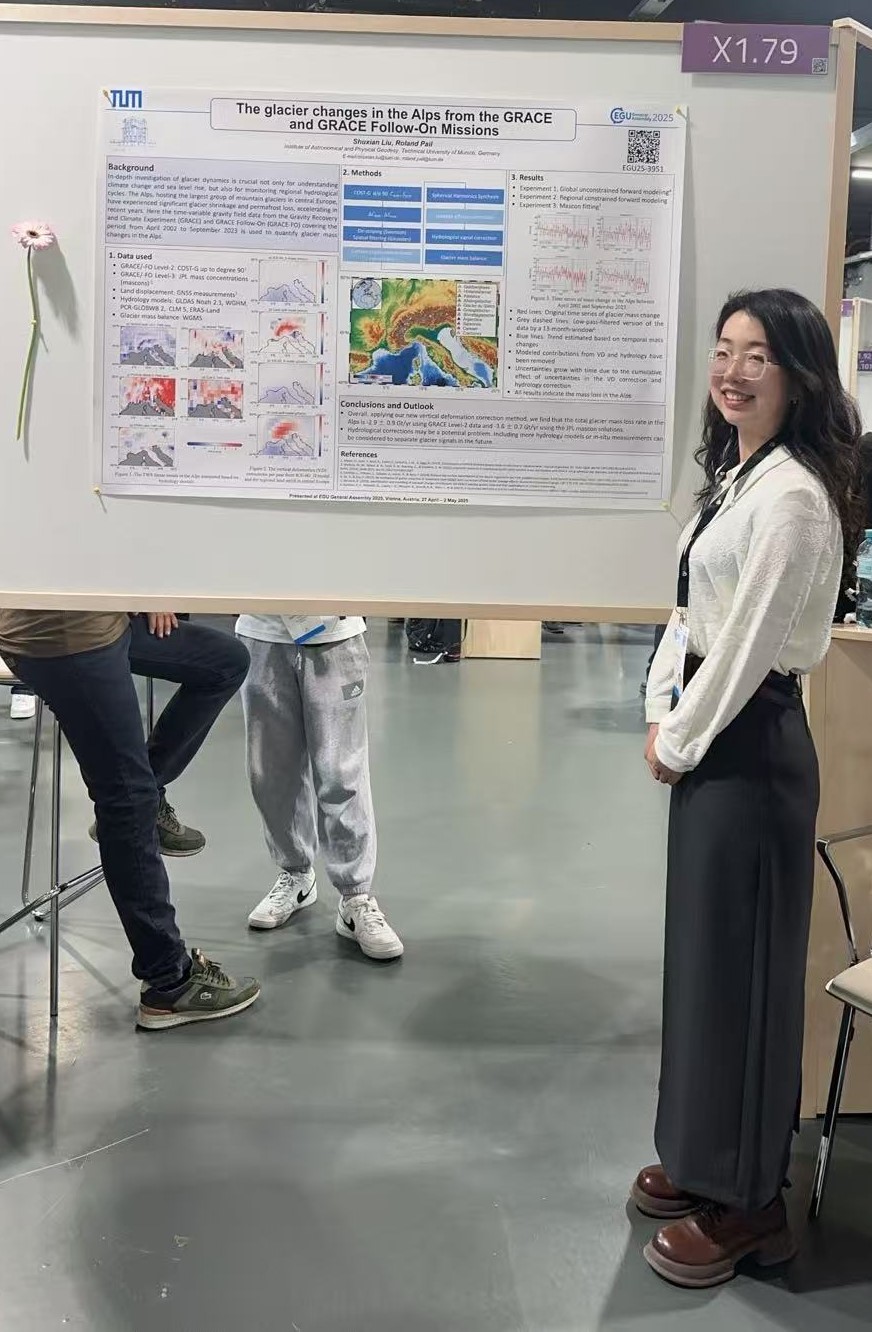
Picture of Shuxian Liu at the EGU General Assembly in 2025. Picture courtesy by Shuxian Liu.
Let’s take a look at your future plans. What are your career and personal aspirations after completing your PhD?
After completing my PhD, I hope to continue in a research‑oriented environment, whether in academia or applied research. I aim to carry forward the resilience, adaptability, and cultural awareness I have gained through working in an international setting and apply those strengths in the next stage of my career and life.
Finally, I would like to close with some advice and reflections. What advice would you give to students considering a PhD abroad, and is there anything you wish you had known before starting your own PhD journey?
My main advice is to stay open-minded, proactive, and mindful of mental well-being. A PhD abroad can be exciting but also overwhelming at times, so building healthy routines, having hobbies, and giving yourself time to adjust is essential. Being patient with yourself and acknowledging your progress helps make the experience more enjoyable.
Looking back, I wish I had known that uncertainty in the early stages is completely normal. Confidence in your research direction grows gradually. I also wish I had understood earlier how important it is to build connections within the research community, discussing ideas with colleagues enhances both academic work and personal experience.
Thanks, Shuxian, for contributing to our series and for openly sharing your experience!
Are you doing a PhD abroad and interested to share your experience, then please send us a message to ecs-g@egu.eu!
– Edited by Marius Schlaak