
This was originally posted on the PLOS Paleo blog Crocodiles are freakin’ amazing animals. They’ve been around for about 250 million years, and throughout this time have survived two mass extinctions, and at least twice decided to hitch up and take to the seas. Their historical diversity, and general weirdness, was vast compared to what we see in modern crocs, which are on the face of it all fairl ...[Read More]
Crocodiles
Crocodiles feeling the heat of extinction
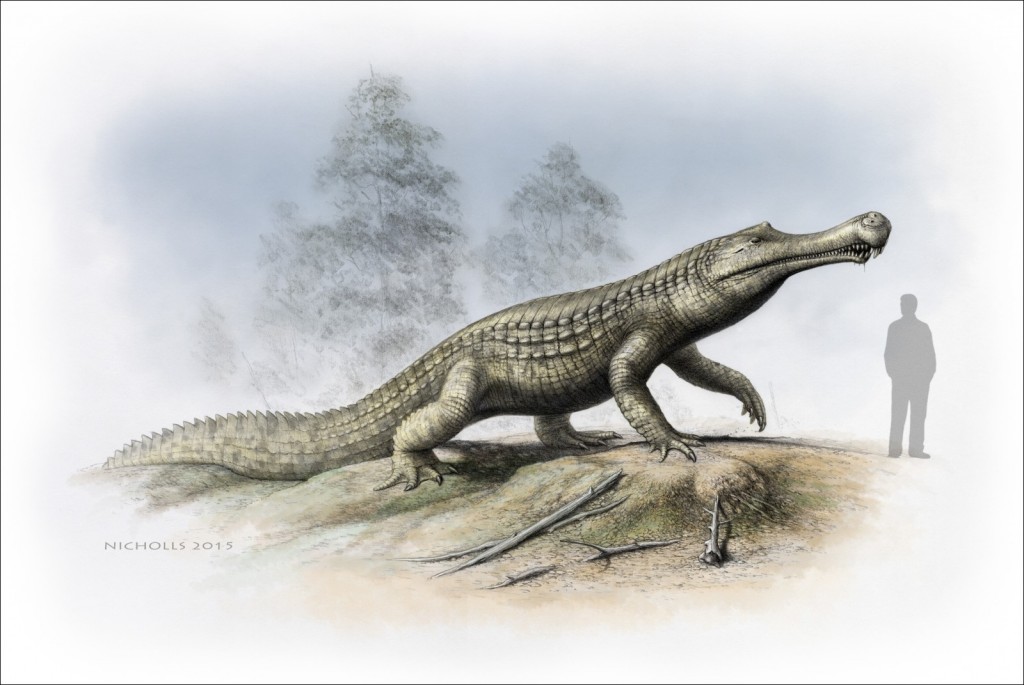
New research on crocodiles shows that a combination of changing sea levels and temperatures were responsible for driving their biodiversity over millions of years. Living crocodiles are threatened by climate change, with 10 out of 23 species at a high risk of extinction. As ectotherms, animals which require external sources of heat to function, they are sensitive to changes in temperature. With 2- ...[Read More]
Nessie dwarfed by new Scottish crocodile
Yes, Nessie had to be in the title. Am I sorry? A little. But not enough to not use it. Colleagues from the University of Edinburgh and myself have described the first Scottish crocodile fossil! It’s from the Isle of Skye, from a time known as the Middle Jurassic, and dates back around 160 million years ago. Based on a partial bit of a jawbone (the dentary), it’s hardly the most specta ...[Read More]
The origin of a second wave of supreme-swimming crocodiles
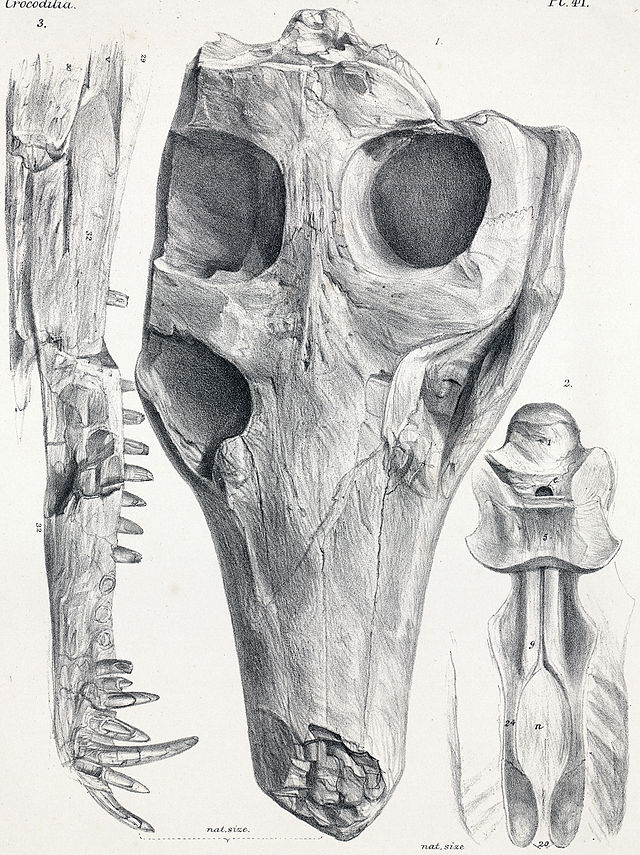
Millions of years ago, crocodiles were far more diverse (and weird) than the ones we still have around today. They ranged from armoured, tank-like forms living on land and feeding on plants, to 9 metre long fully-fledged swimmers out in the open oceans. In the Jurassic period, most of the crocs we know of were of this second kind, the whole marine forms. These comprised a group known as thalattosu ...[Read More]
Your bite or mine?
It rises from the dark waters like some behemoth from the deep, and lets out a blood-curdling roar. It’s feeding time. One of the most iconic scenes from Jurassic Park III is where the long-snouted, sail-backed giant theropod dinosaur Spinosaurus emerges from underwater to try, yet again, to eat our beleaguered rabble of misfortunates. It’s always been the way these dinosaurs have been portrayed, ...[Read More]
Crocodiles are so hard, they even eat fruit
Seed dispersal by animals is incredibly important for plants to help them occupy new areas of land and reproduce. Usually, this happens using bugs, birds, or intrepid kittens, but probably the last animal on this planet you’d expect to disperse seeds is crocodiles – you know, those big beasties that take down bison for a snack. Well, turns out, they do, and it’s a process known as saurochory. Not ...[Read More]
Green tea and Velociraptors turns into beer and dwarf crocodiles
I’m in Berlin. I’ve just managed to find a chicken donner kebab, and am pausing research briefly to write this. I’m currently on leave from London, with a ridiculously hectic couple of months ahead: I’ve just been to Munich to see a dwarf crocodile specimen, Alligatorellus beaumonti (from Bavaria), which conveniently happened to coincide with Oktoberfest, and am now here to ...[Read More]
That’s one small step for dinosaur-kind..
This is a guest post by Collin VanBuren. He’s currently starting his PhD at the University of Cambridge researching the effects of climate change on living and fossil frogs, as well as the relationship between the shape of anatomical structures and their function. He loves the outdoors, biomechanics, and conservation, and regularly tweets about these subjects on his Twitter account (@CollinV ...[Read More]
Dwarf crocodiles in Munich
My PhD consists of two parts. The first is investigating the dynamics of biodiversity across the Jurassic/Cretaceous interval about 145 million years ago. I want to see if when we consider the biases of the fossil record whether there was a ‘hidden’ mass extinction, and what were the ecological, physiological or environmental factors that correspond to this. This involves looking at turtles, birds ...[Read More]
Horse poop, frozen rhinos, and crocodile skulls. All is well at the Royal Veterinary College.
Following on from the adventures in the Natural History Museum in London, checking out some of their extant crocs and the material of Theriosuchus pusillus, a dwarf croc from the Upper Jurassic of England, I made a trip to the Royal Veterinary College just north of London to see what they had on offer. John Hutchinson was kind enough to sort things out at short notice, and I actually got to check ...[Read More]