
This was originally posted here. Mass extinctions are insanely catastrophic, but important, events that punctuate the history of life on Earth. The Jurassic/Cretaceous boundary, around 145 million years ago, was originally thought of to represent a mass extinction, but has subsequently been ‘down-graded’ to a minor extinction event based on new discoveries. However, compared to …[Read More]
Cretaceous
New fossil croc on the block
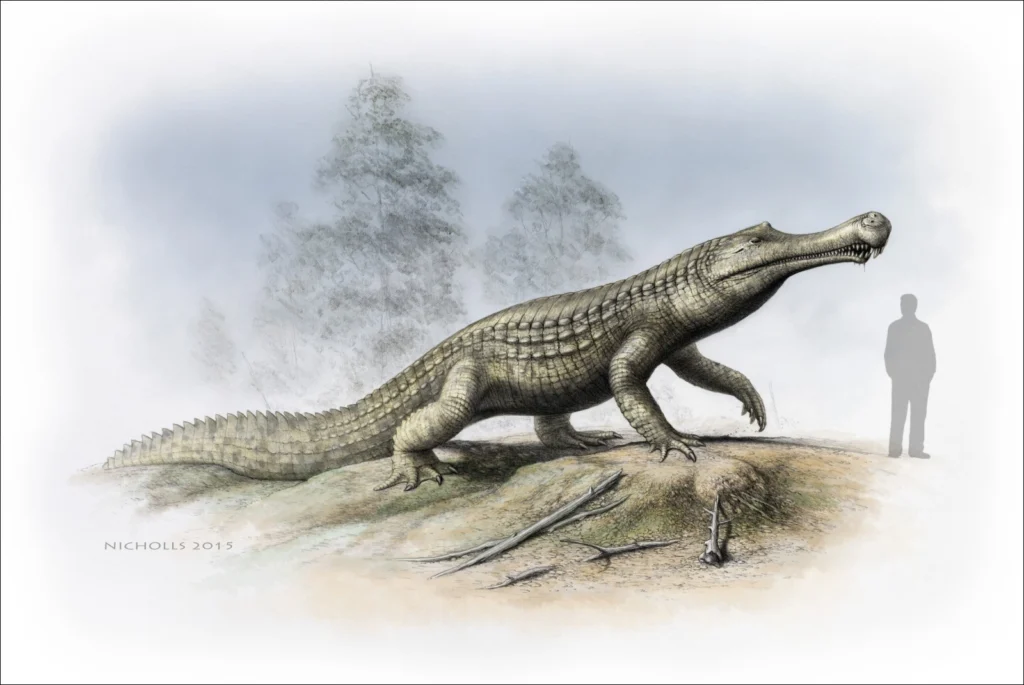
This was originally posted on the PLOS Paleo blog Crocodiles are freakin’ amazing animals. They’ve been around for about 250 million years, and throughout this time have survived two mass extinctions, and at least twice decided to hitch up and take to the seas. Their historical diversity, and general weirdness, was vast compared to what …[Read More]
Crocodiles feeling the heat of extinction
New research on crocodiles shows that a combination of changing sea levels and temperatures were responsible for driving their biodiversity over millions of years. Living crocodiles are threatened by climate change, with 10 out of 23 species at a high risk of extinction. As ectotherms, animals which require external sources of heat to function, they …[Read More]
Last dinosaur of its kind found in the land that time forgot
In terms of iconic dinosaurs, the gargantuan sauropods are certainly up there. Along with the mostly meat eating-theropods, and herbivorous and often armoured ornithischians, they form one of the three major groups, or clades, of dinosaurs, and were the biggest animals to ever walk this Earth. The end of the Jurassic period, some 145 million …[Read More]
Double-whammy signifies the demise of the dinosaurs
The meteoric impact that wiped out the non-bird-line dinosaurs is an iconic image of life and death on Earth. It signifies a point in time when life changed forever. It took from us animals that we will never see again. But was it just a single strike that created these winds of permanent change? The …[Read More]
Was the diversity of feeding styles in giant turtles a key to their suckcess?
Sometimes, it can be difficult to figure out how ancient organisms used to eat. Part of the problem is that we can never actually see extinct animals eating (until we invent time-travel.. *taps fingers impatiently at physicists*), and often it can be hard to work out how something ate based just on its anatomy. Sometimes …[Read More]
What do we know about the origin of flowering plants?
This is a guest post by Dan Peppe. He is an Assistant Professor in the Geology Department at Baylor University. His research interests are focused on reconstructing ancient climates and ecosystems in North America and East Africa and on developing new and improved palaeoclimate and palaeoecological proxies using methods in paleobotany, sedimentary geology, and paleomagnetism. More …[Read More]
Your track or mine?
How do you tell between different dinosaurs, when you don’t have any dinosaurs? Trace fossils, like footprints, are ghosts of dinosaurs past, remnants of life entombed within the rocks. Palaeontologists and ichnologists (scientists who study trace fossils, not fish) often used to get confused by the question of matching a dinosaur track to its maker. …[Read More]
Plan of action!
Crikey, it’s been 3 months already?! *panics* At Imperial College, new PhD students have to produce an initial plan of study within the first three months of setting off, and submit it for independent assessment. Having uploaded mine just now (not in the slightest bit late..), I figured I’d share it here! It’s a broad …[Read More]
Horsedrosaurus, the dinosaur that wanted to be an equid.
The title of this makes no sense, but kind of emphasises the main point of this post. It’s pretty much a summary of a new paper, one on the feeding habits of hadrosaurid dinosaurs. These are the big advanced ornithopods, often considered to be the ‘bland’ lineage of ornithischians, and referred to as the ‘cows …[Read More]