
For some years now, Mary Schweitzer and her team have been researching the idea that organic molecules can be preserved for millions of years, specifically within dinosaurs. They have used a plethora of chemical and biotechnological techniques to demonstrate that, within animals like Tyrannosaurus rex, it is possible to find the residue of structures such as blood vessels and even proteins. Naturally, her research has been met with a whole wad of stiff resistance from the scientific community, seemingly for no other reason than “We don’t like the sound of that..”. Scientific rigour ftw!
Where did all the mammoths go?
Let’s go meta. Recently, ecologist extraordinaire Dr. Jacquelyn Gill (or is it Professor cos of that weird American system?) wrote a wonderful review article on the extinctions that affected many large mammal species during the last 50-10,000 years. This period is known as the Quaternary, and was a time when ice ages were running rife between warmer periods, and herds of enigmatic mammals roamed the steppes. It’s also a time when many wonderful animals, such as mammoths, disappeared from our planet forever, apart from rare fuzzy sightings from drunk Russians that later turn out to be a bear, or nothing. The result is that although we have a spectacular range of mammals decorating our landscapes today, this is but a shadow of mammals’ true splendour back just a few thousand years.
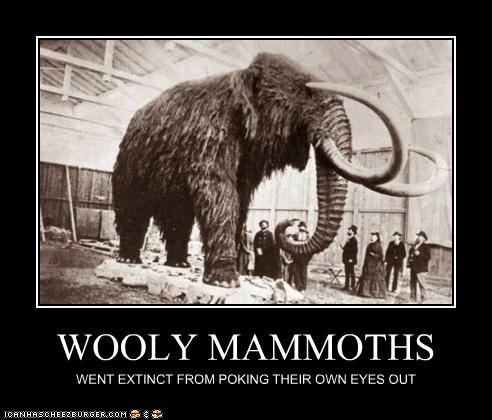
Legit scientific claims (source)
Citizen science in ecology and evolution? Sounds apps-olutely fantastic.. *tumbleweed*
There’s a lot of talk these days about science communication. Some people spend their lives debating the differences between outreach, public engagement, and science communication, and how they all mean different things. As a scientist, and I’m quite sure I can speak on behalf of the entire community, we don’t give a toss what you call the model – let us interact with people. And by interact, we mean get reciprocal. This is true science communication or whatever fancy name you want to call it, and it’s where people give something back and get physical with the science. Great platforms for this include discussion sessions, café scientifiques, science festivals, and of course, citizen science.
What are the key questions in palaeoecological research?
Last year, a throng of palaeoecologists from the world around descended into Oxford to discuss what the 50 most pressing questions in palaeoecology are. I was happy to see some great scientists and communicators among them, including Anson Mackay, Jacquelyn Gill, and Gavin Simpson, which gives me real hope that these questions were crafted with more than just ‘science for the sake of science’ in mind, and I think this really shines through in their article.