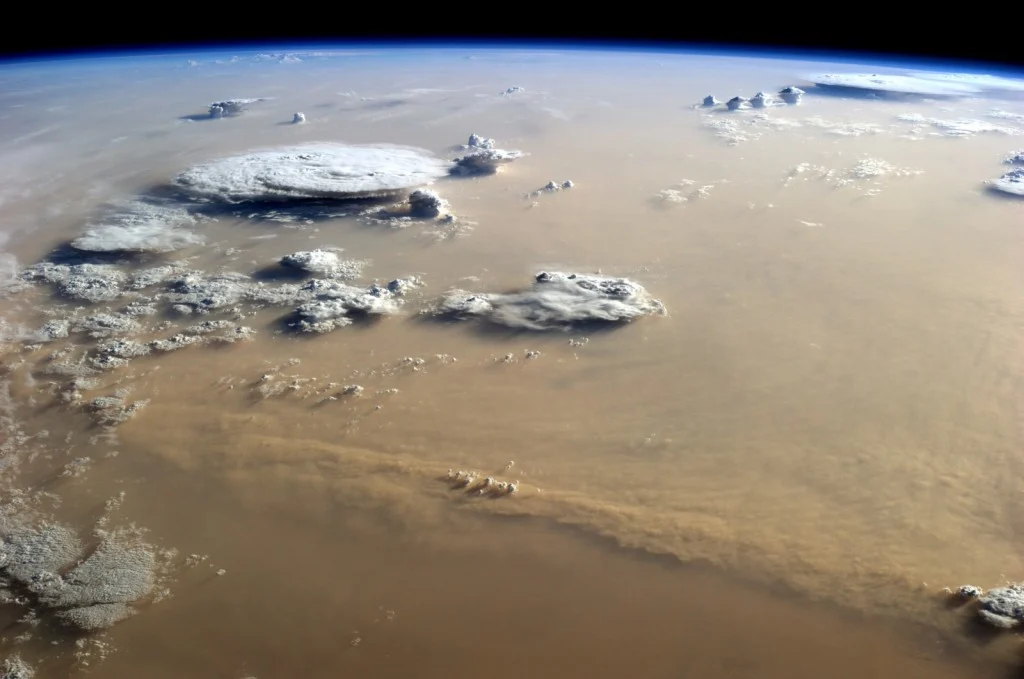
The short lifetime of aerosol particles in the atmosphere means that they tend to be found concentrated in regions close to where they were formed. As they only last for days to weeks in the atmosphere, they don’t travel too far as the Earth’s winds aren’t able to fully mix the air over such a short period. This short lifetime should also mean that any changes in the emissions of ...[Read More]
IPCC
Wuthering heights
Aerosol particles typically have short life spans in the atmosphere (days to weeks) but they can travel far and wide in that time. They can be lifted up to new horizons, higher and higher in the atmosphere. This is important for their impact on our climate, for example, at least 20% of the uncertainty in the climate impact of black carbon aerosol is due to differences in its vertical distribution. ...[Read More]
EGU 2014: Measuring aerosol climate impacts from Space
In order to understand past climate change and to better project future changes, we need to understand how humans disturbed the radiative balance of our planet. Aerosols are one component of this disruption. The final report from the Intergovernmental Panel on Climate Change (IPCC) physical science basis concluded that aerosols dominate the uncertainty in the total anthropogenic radiative forcing. ...[Read More]
Aerosols and the pause
There is a new commentary piece in Nature Geoscience by Gavin Schmidt and colleagues on ‘Reconciling warming trends’. The paper investigates several potential causes for the discrepancy between climate model projections and the recent ‘slowdown’ in global surface temperatures, which is nicely illustrated on Ed Hawkins’ Climate Lab Book blog. One of the aspects the pap ...[Read More]
What did the IPCC say about aerosols?
Aerosols dominate the uncertainty in the total anthropogenic radiative forcing. A complete understanding of past and future climate change requires a thorough assessment of aerosol-cloud-radiation interactions. This is one of the conclusions about aerosols and their impact on our climate from the the final report from the Intergovernmental Panel on Climate Change (IPCC) on the physical science bas ...[Read More]