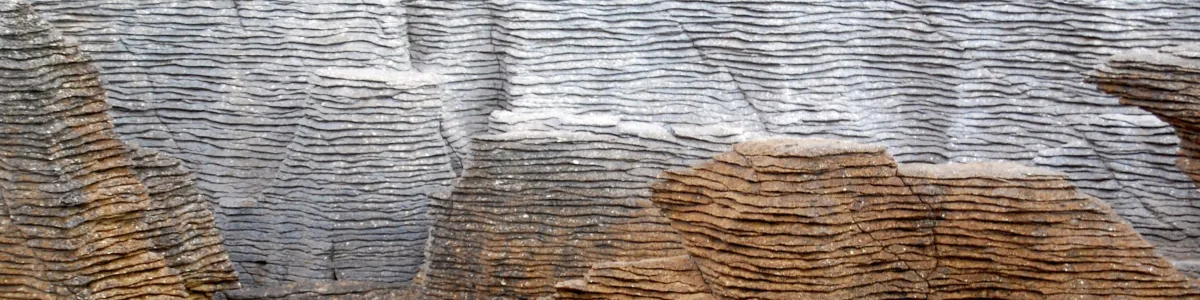
Detail of a photo: Weathered limestone cliff built of hundreds of thin stacked layers like a pile of pancakes, grey at the top and orange-brown below, with a small dark pool in a hollow.
An Atom's-Eye View of the Planet

About

Simon: the man who fell to Earth Sciences? Initially (many moons ago) convinced that I would study engineering at University, I was drawn to materials science before seeing the light and turning to mineralogy. My early research focussed on the thermodynamic forces driving high-temperature transformations in silicates such as feldspars; rather a narrow field, but good training for the application of these concepts to a diverse range of problems in Earth Sciences and beyond. Symmetry and structure at the atomic scale caught my attention, and I have spent more than a quarter century in research investigating how (at the atomic scale) the solid Earth responds to changing temperature, pressure and chemistry. Where atoms go, and how they move, determines so many of the physical and chemical properties of our planet. My research spans the range of mineral environments from the biosphere to the deepest inner core.

Both through teaching undergraduate Earth Sciences and as a father of three, I have become more and more convinced of the importance of communicating the fascination of geosciences to a general audience. I started by posting short articles on The Earth Story , a Facebook community of half a million or so folk interested in the Earth. I also tweet occasionally as @Sim0nRedfern, and as a new venture I am about to learn how science journalism works, acting as a British Science Association media fellow for a short while.

When I’m not doing my own research, helping others with theirs, teaching the next generation of Earth scientists, or running around after the kids, I go running for my own enjoyment … running long and slow, ideally in mountains, and finishing the odd marathon here and there along the way.

The opinions expressed in the An Atom's-Eye View of the Planet blog are those of the authors, whose views may differ from those of the European Geosciences Union.

About EGU

The European Geosciences Union (EGU) is the leading organisation for Earth, planetary and space science research in Europe. With our partner organisations worldwide, we foster fundamental geoscience research, alongside applied research that addresses key societal and environmental challenges. Our vision is to realise a sustainable and just future for humanity and for the planet.

It is a non-profit international union of scientists with about 23,500 members from all over the world. Membership is open to individuals who are professionally engaged in or associated with geosciences and planetary and space sciences and related studies, including students and retired seniors.

The EGU publishes a number of diverse scientific journals, which use an innovative open access format, and organises topical meetings, and education and outreach activities. It also honours scientists with a number of awards and medals. The annual EGU General Assembly is the largest and most prominent European geosciences event, attracting over 22,000 scientists from all over the world in the year 2026. The meeting’s sessions cover a wide range of topics, including volcanology, planetary exploration, the Earth’s internal structure and atmosphere, climate, as well as energy and resources.

The EGU was established in September 2002 as a merger of the European Geophysical Society (EGS) and the European Union of Geosciences (EUG), and has headquarters in Munich, Germany.