Hello readers!
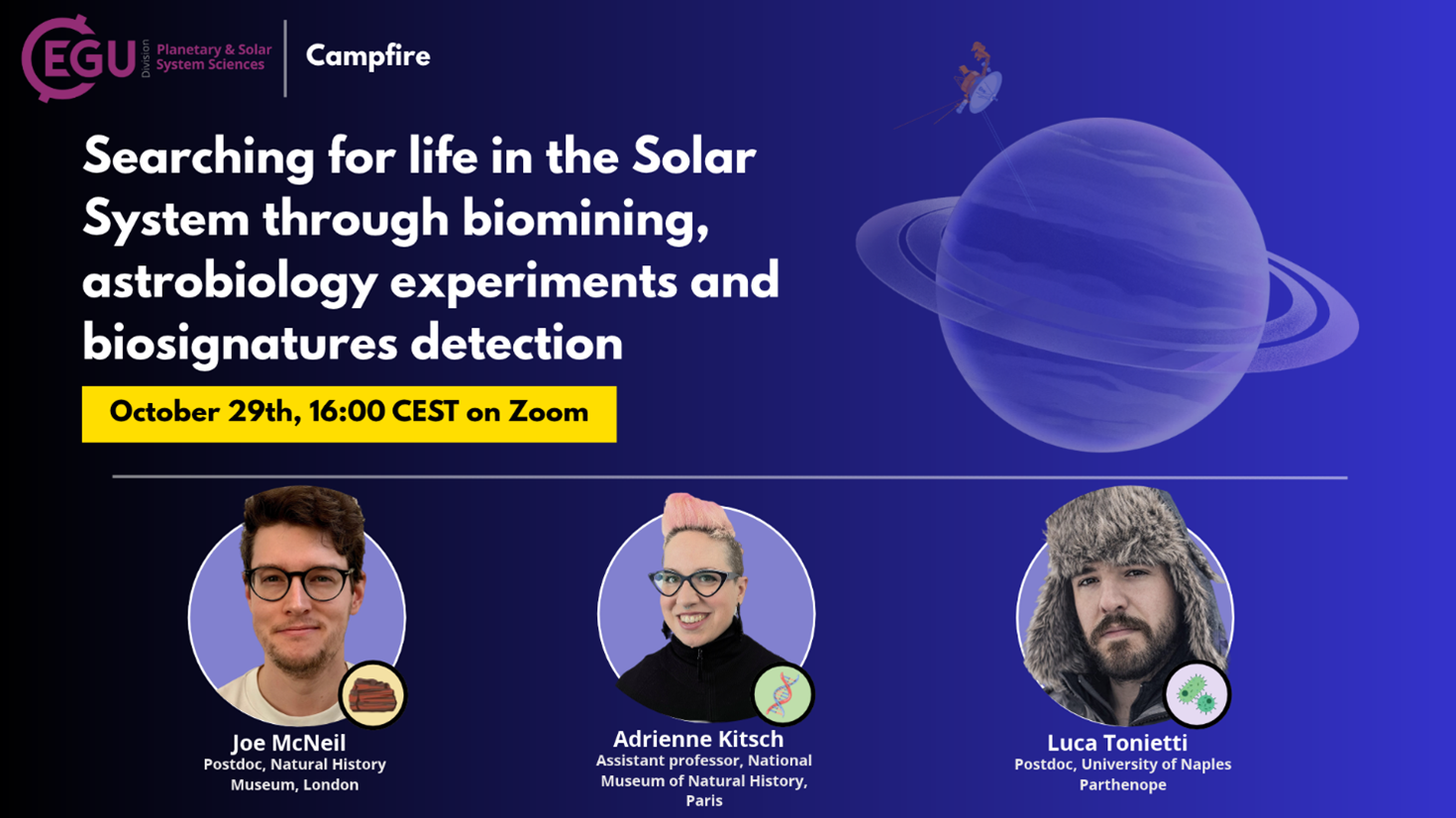
We’re thrilled to announce the new campfire event of the EGU planetary and Solar System Sciences (PS) Division dedicated to astrobiology, habitability in the Solar System and biomining. Our guests will be Joseph McNeil (Natural History Museum of London), Adrienne Kish (National Museum of Natural History of Paris) and Luca Tonietti (University of Naples Parthenope).
When? October 29th, 16:00 CEST
Where? On Zoom
Registration is required to join the event. Save your seat here!
What are the limits and possibilities of life in the Universe? Space exploration is opening new frontiers, and it keeps challenging our ideas about the origin of life and habitability beyond Earth.
From choosing the best places to hunt for biosignatures on Mars, to understanding how microorganisms behave in extreme conditions, all the way to using microbes to extract valuable elements from geological materials in space, astrobiology is a fascinating field that never stops moving forward. This campfire brings together three in-depth segments of the discipline. They will show us how life signatures are studied in space environments, how survival mechanisms work, and what the new frontiers of in situ resource exploitation look like.
Meet the speakers and their topics!
Joseph McNeil: Searching for life on Mars
Joe is a planetary scientist fascinated by how planetary surfaces record the history of the Solar System over billions of years. He is currently a postdoctoral researcher at the Natural History Museum in London, where he uses orbital and rover data to investigate the geological evolution of Mars, as well as the role of impact cratering across the Solar System. He holds a PhD in Planetary Science from the Open University.
His work has improved our understanding of Mars at a range of scales, from global geological processes to high-resolution studies in Oxia Planum, the future landing site of the Rosalind Franklin Rover Mission. Joe is involved in the mission as a science team member of two of its instruments: Enfys (the rover’s IR spectrometer) and PanCam (the rover’s camera system). Joe is also a science team member on the CaSSIS multispectral camera onboard ESA’s Trace Gas Orbiter. Outside of work he has a passion for photography, Formula One and video games.
About his talk: Oxia Planum, on Mars, is an ancient, clay-rich plain and the future landing site of the Rosalind Franklin Rover. Launching in 2028 for arrival in 2030, Rosalind Franklin will search for signs of past or present life (“biosignatures”), using its inbuilt drill to retrieve pristine samples from up to two meters below the Martian surface, before analyzing them in its ‘Pasteur’ suite of instruments.
Orbital reconnaissance of the landing site using remote sensing data is fundamental to the mission’s success: without this, the rover team would lack regional geological understanding, local context with which to place its samples, and any idea of where best to search for biosignatures.
In this talk, Joe will describe the geology of two key landing site units with high biosignature preservation potential: the extensive phyllosilicate-bearing plains, and the hydrated silica-bearing deposits. These units display evidence of past interaction with water, and thus are key targets for geochemical analysis with Rosalind Franklin in its search for life.
Adrienne Kish: Life in extreme conditions – a matter of chemistry rather than environment
Dr Adrienne Kish was trained as an extremophile microbiologist in Canada, France, and the USA prior to establishing her research laboratory at the National Museum of Natural History (MNHN) in Paris. She is currently taking part in the upcoming Exocube experiment on the EXOBIO-1 astrobiology exposure mission, destined for placement outside the International Space Station. Beyond the lab, she is involved in representing microbiology and astrobiology as a member of the ESA Life Sciences Working Group and the CNES Exobiology working group, and she is Vice-Chair of the European Astrobiology Institute. In her free time, she enjoys searching out urban art and she has never stopped dreaming.
About her talk: In this talk, Adrienne will explain why microbes can live in extreme environments, based on what happens to the basic building blocks of cells (lipids, proteins, DNA, water). The goal is to turn the idea of extreme conditions on its head to better understand if there are limits to life, what those might be, and what that tells us about the potential for life elsewhere.
The talk is for everyone interested in searching for traces of life, whether living or long gone, in extreme environments and even on other planets, but without a background in microbiology. It will be the perfect chance to ask all those questions you may have never dared to ask! Adrienne hopes that, by the end of the session, you’ll have a clearer picture of how to design instruments for detecting ‘biosignatures’, and of why microbes can survive in unusual places.
Luca Tonietti: Space biomining
Luca Tonietti is an astrobiologist and postdoctoral researcher at the University of Naples “Parthenope”, where he studies microbe-mineral interactions, space biomining, and cosmic dust. He holds a PhD in Astrobiology. He is also affiliated with INAF (National Institute for Astrophysics) and CNR (National Research Councill), and contributes to several international research projects, including DUSTER, ESA’s Comet Interceptor and ExtreMoon, where he serves as Co-Investigator.
Beyond research, he enjoys martial arts, photography, philosophy and poetry.
About his talk: As humanity prepares to explore the Moon, Mars, and beyond, the sustainable utilization of extraterrestrial resources is becoming increasingly important. Transporting all the necessary materials from Earth is costly and logistically challenging, making in-situ resource utilization (ISRU) a key component of future space exploration.
On Earth, microorganisms have been interacting with minerals for billions of years, driving biogeochemical cycles and transforming their surrounding environments. Some of these interactions can be exploited through biomining, a biotechnological approach that uses microorganisms to mobilize and recover valuable elements from geological materials. But could these biological processes work beyond Earth?
Luca will explore the potential of space biomining, discussing experimental research on microbial interactions with terrestrial and extraterrestrial materials, including studies conducted under different space conditions. Particular attention will be given to the opportunities and limitations of microbial resource extraction in space, from recovering technologically valuable elements to supporting more sustainable and self-sufficient extraterrestrial settlements.

Before the campfire, we asked our speakers a few questions. Here’s a snippet of what they told us!
What inspired you to get involved in astrobiology?
Adrienne says: “I always loved space science, and later combined that with microbiology to end up in astrobiology by studying microbes in extreme environments. I found my path by trying different kinds of science and talking to a lot of people before finding the science that just fit for me “.
Joe, on the other hand, says that getting involved with the Rosalind Franklin Rover when he started his PhD back in 2019 was incredible and is what has inspired him ever since. It’s now ready to launch for 2028, and his enthusiasm for the mission hasn’t diminished at all. He points out that the question “are we alone in the universe?” is just about the biggest humanity can ask. After nearly seven years investigating Oxia Planum from orbit, he cannot wait to start exploring it from the ground and help answer that big question.
Luca started out as a dinosaur-loving kid: “As a child, I originally wanted to study dinosaurs, but my scientific interests eventually took me in many different directions, from theoretical chemistry to zoology and botany, and later to microbiology, exoplanets, and cosmic dust. Looking back, I realize that astrobiology was never really a destination I had planned to reach, but rather a natural consequence of my curiosity across different scientific disciplines. More than a specific career goal, astrobiology represents, for me, a way to explore the countless connections between life, matter, and the Universe”.
What do you think is the future of astrobiology research on planetary bodies and how could this impact our society?
Luca’s answer is very insightful: “I believe the future of astrobiology and space biotechnology will extend far beyond the search for extraterrestrial life, raising fundamental questions about our relationship with other worlds, including who has the right to access, exploit, and claim ownership of extraterrestrial resources. As humanity expands its presence beyond Earth, we will need to reconsider the ethical and environmental responsibilities that come with planetary exploration. Above all, I believe that discovering life beyond Earth would represent the greatest revelation in human history since the discovery of fire, profoundly transforming our understanding of life, our place in the Universe, and perhaps even our relationship with one another “.
On a similar note, Adrienne says that “looking for the potential for life on other planets makes us cognizant of how rare life is and that it needs to be protected. The Earth is as far as we currently know, unique in hosting life. This puts humanity into perspective as the latest arrival on this spaceship we ride as we orbit our Sun”.
Joe is enthusiastically looking forward to the new findings from upcoming missions: the future of astrobiology is really very bright across the Solar System. For Mars, the next big leap will be digging down into the subsurface with Rosalind Franklin’s drill, because we’ll reach rocks that haven’t been exposed to the harsh Martian environment for billions of years… Who knows what’s buried below the surface? Of course, I’m also very excited for ESA’s JUICE and NASA’s Europa Clipper to start exploring the Jovian system in a few years’ time. Discovering evidence of life anywhere beyond Earth would dramatically shift humanity’s perspective on our place in the universe”.
What do we know about habitability in the Solar System?
Joe stresses the relevance of time: “When we evaluate our Solar System’s habitability, time is just as important as place. Take Mars, for example: it’s currently cold, dry, and heavily irradiated at the surface, but about four billion years ago we know that it was far more hospitable. So, as our Solar System evolves, so do these planetary niches where life might thrive. Who’s to say Venus wasn’t the most habitable place in the Solar System billions of years ago, when a fainter sun might have supported liquid water at its surface? Today, our best bet (other than the Earth of course!) is probably in the subsurface oceans of Europa and Enceladus”.
Luca agrees with Joe, and goes a bit deeper: “Our Solar System hosts several environments of astrobiological interest, from the ancient habitable landscapes of Mars to the subsurface oceans of Europa and Enceladus, where liquid water and chemical energy sources may provide conditions suitable for life. However, I believe we should also renew our efforts to explore the surface of Venus, a world that is extremely hostile today but whose geological and climatic history may hold crucial clues about the evolution of planetary habitability. Understanding why two planets as similar as Earth and Venus followed such dramatically different evolutionary paths could fundamentally change how we assess habitability, both within our Solar System and on exoplanets”.
Adrienne dives into the microbiological and evolutionary aspects: “Cell survival largely depends on two key elements: 1-the chemical limits of the basic building blocks of the cell, and 2-the adaptations of cells obtained through evolutionary processes in response to changing planetary conditions over geological time. What we currently know about life on Earth has shown that it is specific combinations of stress factors that limit life when those factors require contradictory cellular adaptations for the types of cells that exist today. It’s not about the conditions, but rather the chemistry of cells “.
Where do astrobiology and space resources meet?
Adrienne sees one continuum: “Astrobiology is found on both sides of the ‘Exploration-Enabled’ and ‘Exploration-Focused’ paradigms. Microbes can be either studied for habitability or used as factories for in situ resource utilization. In the end, it’s all part of the same continuum of science, with one side more fundamental and the other more applied “.
Same as Joe, who agrees that “The overlap here is significant! Astrobiologists love to ‘follow the water’, because life as we know it depends on it for so many reasons. On Mars, the water ice and hydrated minerals we study to try and find evidence of past life are the exact same resources future explorers will need to survive. Extracting those resources may require us to use biological agents, such as microbes. As soon as we start to think about using microbes for resource extraction, however, we must implement strict planetary protection measures to avoid contaminating the very environments we wish to explore.”
Finally, Luca sees microorganisms as partners: “I believe the connection between astrobiology and space resource utilization lies in understanding how life interacts with and transforms planetary materials. Through processes such as biomining, microorganisms could help us extract valuable elements from extraterrestrial rocks, recycle resources, and reduce our dependence on supplies transported from Earth, while the study of these same interactions can provide insights into planetary habitability and the formation of biosignatures. In this sense, microorganisms are not only potential targets in our search for extraterrestrial life, but could also become essential partners in the sustainable exploration of other worlds”.
Want to hear more? Join us at the campfire and ask them yourself!
Edited by the PS Blog Team (Gabriele Boccacci, Giulia Nejat, Janko Trisic Ponce and Salvatore Buoninfante)
Credits: Canva独家插画 via Canva.com; imagineHarry from sketchify via Canva.com; Eucalyp from amethyststudio via Canva.com; sketchify via Canva.com; Sketchify Education from Canva Creative Studio via Canva.com; Canva AI Elements Lab via Canva.com