![[ECS Interview] On the surface of Churyumov-Gerasimenko with Philae and Anthony](https://blogs.egu.eu/divisions/ps/files/2016/10/Rosetta_impact_1280-e1477918588515-700x400.jpg)
Rosetta recently made a breathtaking dive towards the surface, bringing a wealth of science close from the surface, but also bringing the mission to its end. The operations might be over, but the science is not as there is still a lot of data to analyse, especially for the next generation of cometary scientists.
To illustrate this new generation, we asked a few questions to an early career scientist: Anthony Lethuillier who recently defended is PhD thesis and is now a post-doc at the LATMOS laboratory near Paris in France.
What is your background?
I studied geology and geophysics during my bachelor and master courses and it was only during the last year of my masters that I specialized in planetary science. In October 2013 I started my thesis at the LATMOS lab. My thesis was dedicated to the data collected on the nucleus of the comet Churyumov-Gerasimenko by the SESAME-PP instrument on-board the Philae lander.
You were working on the Philae lander, could you tell us more about what you were doing?
My thesis was dedicated to the data acquired by the SESAME-PP instrument on-board the Philae lander. The objective of SESAME-PP was to measure the electrical properties of the close subsurface of the comet (down to 1m). To achieve this the instrument uses transmitting electrodes (located on one of the feet of the lander) to inject a signal into the subsurface, it then records this signal on two receiving electrodes (located on the two other feet of the lander). The difference in amplitude and phase of the transmitted and received signal allows us to derive the electrical properties of the subsurface. These properties are the dielectric constant and the electrical conductivity and they depend on the composition and temperature of the material located in between the electrode. Once these values are known we perform lab measurements on the electrical properties of potential analogues to try and determine the composition of the subsurface.
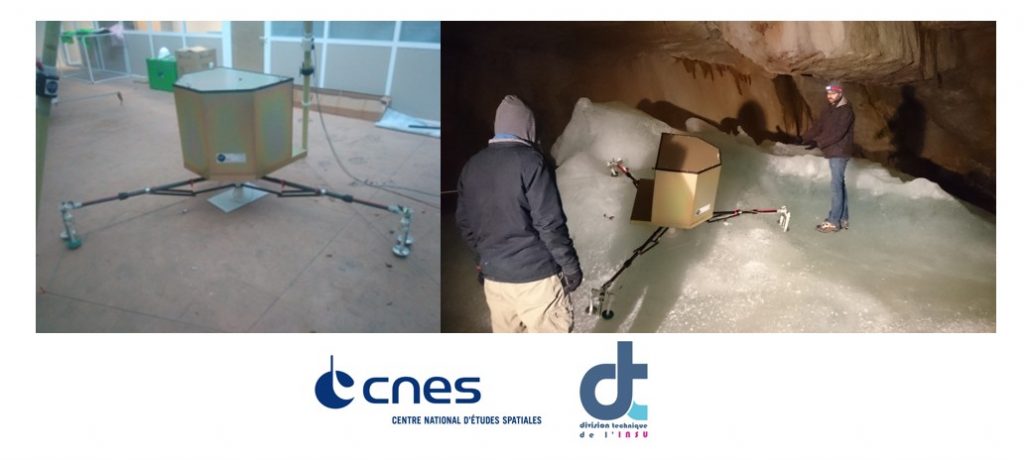
1:1 replica of Philae in tests in LATMOS, France (left) and in in-situ simulations in Dachstein ice caves in Austria.
Credit: A. Lethuillier/CNES/LATMOS
To derive the electrical properties I built 3D numerical model of the lander and its close environment. We also used a replica (scale 1:1) of the instrument and the lander we built to validate our method. This replica was used during field tests in the Dachstein ice caves in Austria (the closest we could get to a surface similar to a cometary surface).
Philae had a bit bouncy landing, wasn’t that a problem for you?
Yes it was for two reasons, the first is that the Lander entered a backup mode in which our instrument only performed part of the measurements it was supposed to do. The second, more important, problem was that the environment was far from flat and the position of the lander was unknown. To properly derive the electrical properties we need to know as precisely as possible the topography of the environment and the instruments attitude with regards to the surface.
Despite these limitations, using the available information on the lander’s position, we were able to constrain the porosity of the subsurface using accurate 3D numerical models.
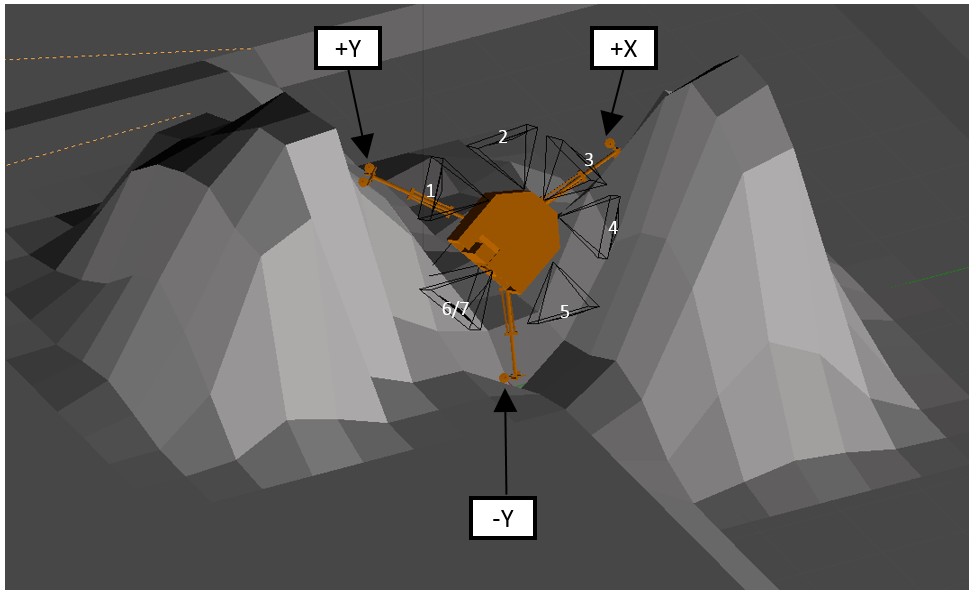
3D modeling of the position of Philae after it landed in the Abydos region on the comet.
Credit: A. Lethuillier/CNES/LATMOS
What are your main conclusions then ?
We combined measurements of electrical properties performed on carbonaceous chondrites and on water ice with the measurements performed on the nucleus and found that the first meter of the nucleus has a maximum porosity of 55 %. We are only able to give a upper limit to the porosity due to the limitations explained above and we are not able to provide any information on the dust/ice ratio.
This value can then be compared to the porosity measured by the CONSERT radar which determined that the bulk porosity of the comet was between 70-80%. This lead us to the hypothesis of a consolidated shell covering a more porous interior. This is supported by the results from other instruments.
This shell could be, for example, the result of ice cementing processes where ice from the deep interior sublimates and refreezes when closer to the surface (our measurements were performed during the cometary night when the temperature is not high enough for the ice in the first meter to sublimate).
After a quite long search, Philae has been found. How does that influence your results?
We compared the picture taken by Osiris to our model in a similar orientation and found that our model was quite correct. By correcting our model we will find a more accurate value of the porosity but our conclusions will stay the same (a nucleus more compact on the surface).
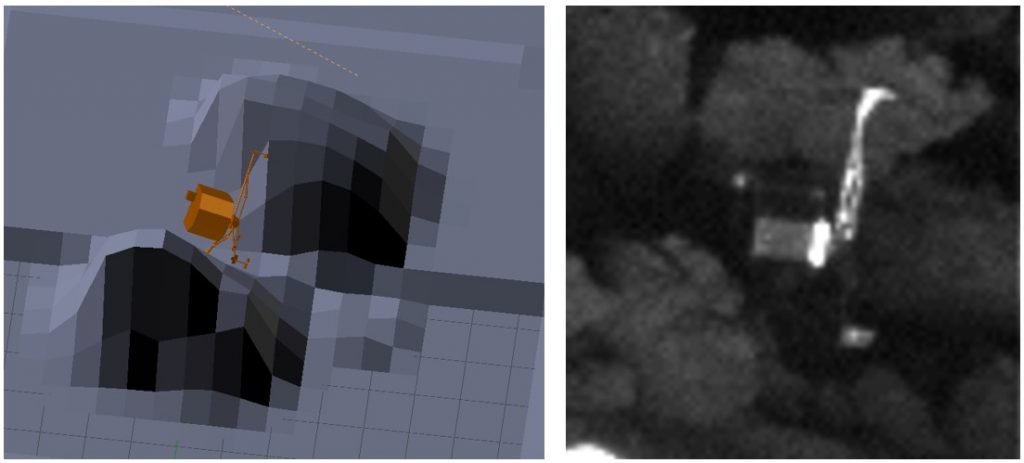
Comparison of the numerical models of the attitude of the lander (left) and the actual position of Philae as seen from Rosetta.
Credit: A. Lethuillier and ESA/Rosetta/MPS for OSIRIS Team MPS/UPD/LAM/IAA/SSO/INTA/UPM/DASP/IDA
In general what Rosetta result stands out according to you?
The ratio of Deuterium with regard to Hydrogen (D/H) in water is an important indicator its origin (theoretical simulations show that its value is dependent on the distance from the Sun at which the water formation took place). The origin of Earth’s ocean water can be investigated with this method: previous measurements on asteroids have shown a good agreement with Earth water. The D/H ratio measured on 67P/C-G is 3 times the ratio measured in the Earth’s oceans, suggesting that Jupiter family comets are not the source of Earth ocean–like water.
The interpretation made by multiple instruments of a consolidated shell covering a more porous interior will probably have a great influence on cometary formation models. The detection the amino acid glycine (found in proteins) and phosphorus (an essential part of DNA) by the ROSINA mass spectrometer is also quite stunning. The presence of geological features (identified by the OSIRIS camera) reminiscent of those found on earth was quite unexpected. The characterization of the comet’s water ice cycle (by the Rosetta spectrometer VIRTIS) is also very important for understanding the evolution of comets in general.
What are your plans for the future?
For the next three months I will be working on the PWA-HASI instrument of the Huygens lander (an instrument similar to SESAME-PP) to try and constrain the porosity of the surface of Titan. After that who knows ? I am looking for a post-doc that would allow me to keep on working on space instrumentation that helps understand the subsurface of planetary objects