This blog post is part of our series: “Highlights” for which we’re accepting contributions! Please contact Emma Lodes and Anna van den Broek (GM blog editor, elodes@asu.edu, a.j.vandenbroek@uu.nl), if you’d like to contribute on this topic or others.
by Grace Nield, Assistant Professor (Research) – Royal Society University Research Fellow at Durham University. Email: grace.a.nield@durham.ac.uk. Website: https://www.durham.ac.uk/staff/grace-a-nield/.
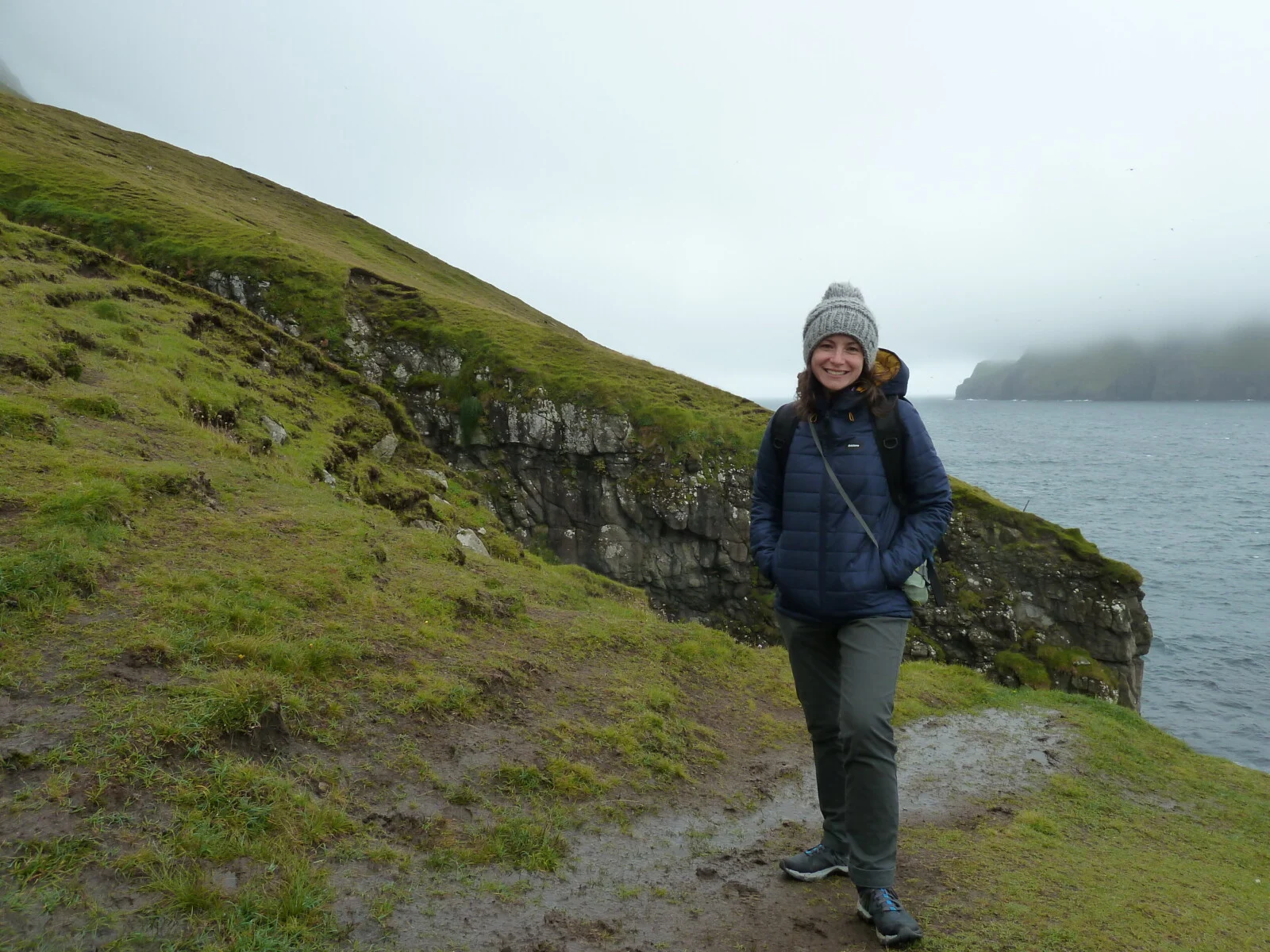
Photo of Grace (PC: Grace Nield).
How would you explain your research in brief?
My research focuses on glacial isostatic adjustment (GIA): the slow deformation of the Earth in response to past and present changes in the weight of the ice sheets. Ice sheets act as a huge weight on the surface of the Earth, and as they melt, the weight reduces, and the underlying mantle flows back into place. This process can take anywhere from decades to thousands of years. I use numerical models and GPS measurements of bedrock displacement to try to understand how fast this process happens.
The reason that it is so important is that the movement of the mantle causes changes to the Earth’s gravity field that can be detected by satellites. When satellite gravimetry data is being used to measure ice loss, the gravity change from GIA contaminates the measurements and needs to be removed. So, accurately estimating ice loss relies on having an accurate GIA model.
How did you get into this field of research?
I began studying geosciences during my undergraduate degree and really enjoyed the mathematical side of geophysics and numerical modelling. After I graduated, I studied for a Master’s in Geotechnical Engineering and started a career with a large multinational engineering company. I really enjoyed the modelling work I was doing with them, but it was only a small part of my job. I decided to look for a more specific numerical modelling role and found a PhD advertised at Newcastle University on Antarctic GIA. It sounded really interesting, so I applied and was lucky enough to get it!
What part of your research do you find most exciting?
I really enjoy modelling – when it works! Sometimes models take months to set up and test, so it’s exciting when they start producing results. It’s like trying to solve a series of problems to get everything working correctly, and I like the challenge! I also enjoy presenting at conferences; there’s always someone to offer a fresh perspective.
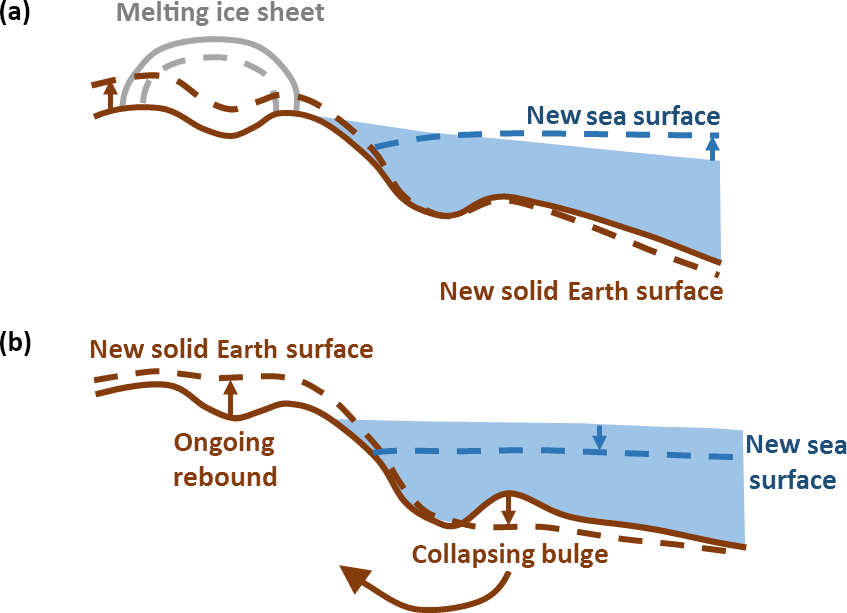
Conceptual figure showing the concept of GIA (Credits: Grace Nield).
What has been the biggest challenge of your career?
I think the biggest challenge has been working on a series of short-term contracts. It’s difficult to balance focusing on getting results whilst continuously thinking about what comes next and submitting (many!) funding applications. A situation that I’m sure many early-career researchers can relate to.
What do you think has led to your success in the field?
The field of GIA has changed quite rapidly since I began my PhD in 2011, and being able to keep up with the latest advances has been important. For example, seismic tomography has given us information on 3D properties of the mantle, which we can now incorporate into GIA models to make them more realistic. I’ve been lucky enough to work with lots of amazing researchers who have been at the forefront of these advances. Diversification has also been an important aspect of my career. Expanding my research into complementary fields has given me skills and ideas beyond just thinking about GIA.
What do you plan on doing with the Royal Society Fellowship?
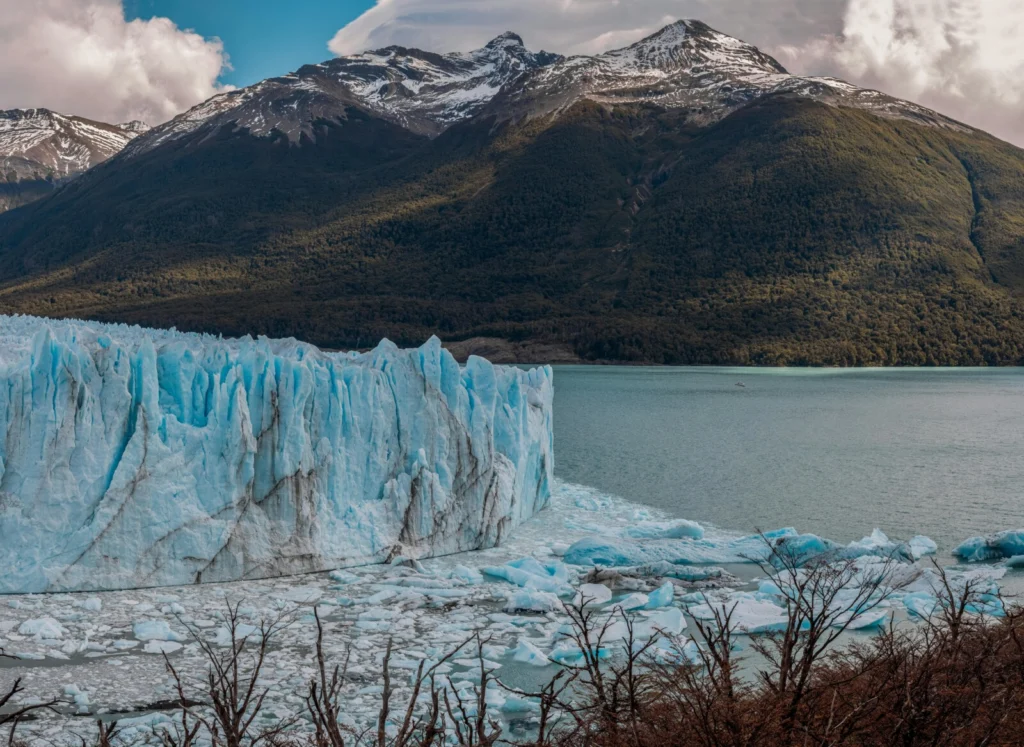
During my Royal Society Fellowship, I will investigate mantle behaviour – how it flows in response to large earthquakes and deglaciation from the Last Glacial Maximum to present. I will focus on Patagonia, which is a region simultaneously undergoing deformation from these two different processes. Studying them in tandem will provide new insight into how the mantle flows under different stress conditions across multiple timescales. This improved understanding will then be applied to West Antarctica to improve GIA models that are used to correct satellite gravity data, leading to more accurate estimates of ice loss and sea-level rise.