
This blog post is part of our series: “Highlights” for which we’re accepting contributions! Please contact Emma Lodes and Anna van den Broek (GM blog editor, elodes@asu.edu, a.j.vandenbroek@uu.nl), if you’d like to contribute on this topic or others.
by Lauren Mc Keown, Assistant Professor – University of Central Florida. Email: Lauren.Mc.Keown@ucf.edu. Website: http://www.laurenemckeown.com/.

Photo of Lauren (PC: Lauren Mc Keown).
What is interesting about the geomorphology of Mars?
Martian geomorphology is interesting because there are a whole host of features that formed via the interaction between the surface and atmosphere, or surface and subsurface, that areindicative of the environment under which they formed, regardless of geological time period. I am mostly interested in features that formed very recently or are still evolving in the present day. To me, the fact that the Martian surface is active seasonally today and that we can observe changes over short timescales is fascinating. I find it especially exciting that by studying these active features, we can link specific landforms to the processes shaping the planet right now and gain insight into how Mars’ current climate influences its landscape. I am also particularly fascinated by surface expressions and dynamics that have no direct analogs on Earth, such as `spiders’ which are radial networks of dendritic troughs detected around the Martian South Pole proposed to form by the seasonal sublimation of translucent CO₂ slab ice and the Solid State Greenhouse Effect, and linear dune gullies, which are linear or sinuous channels found on Martian sand dunes that terminate in circular pits and are proposed to form by levitating sliding CO₂ ice blocks in spring.
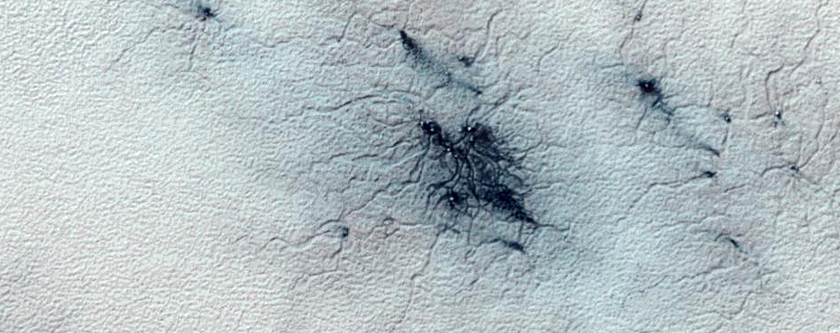
A spider that has formed on Mars (Latitude (centered)
-73.162°, Longitude (East) 330.399; PC: NASA/JPL-Caltech/UArizona).
Mars and Earth share some common processes. For example, wind drives sediment transport on both planets producing dunes and ripples, and freeze‑thaw or frost effects can produce patterned ground in cold regions on Earth similar to Martian analogs. However, the atmospheric conditions, volatile inventory, and surface temperatures are very different on Mars; seasonal CO₂ frost and sublimation play dominant roles in shaping its surface that simply don’t operate here. As a result, many Martian landforms, such as CO₂‑venting `spiders’ (my favourite feature!) or linear gullies linked to dry ice processes, have no direct terrestrial analogues.
My research aims to understand how volatile phase‑change processes like the seasonal sublimation of CO₂, water sublimation and transient brine activity, shape Martian landscapes. I combine high‑resolution orbital imagery with laboratory analog experiments that simulate Martian conditions to investigate how these processes operate and evolve. Ultimately, I want to link observable landforms to specific environmental conditions to reveal how the present-day Martian surface is actively changing.
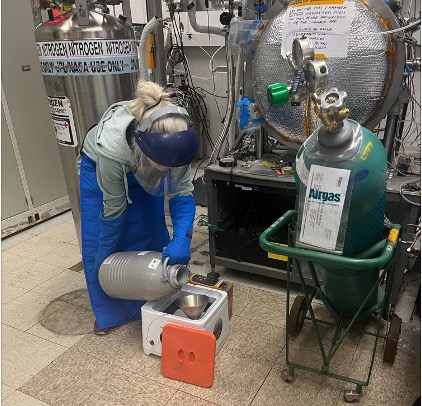
Lauren cooling samples for Martian spider experiments in front of DUSTIE (PC: Lauren Mc Keown).
Since you can’t do fieldwork on Mars, what is your favorite method to research its geomorphology?
Since we can’t conduct fieldwork on Mars, one of my favorite ways to study its geomorphology is through laboratory experiments that simulate Martian conditions. In thermal-vacuum planetary simulation chambers, we can recreate aspects of the Martian environment, such as low atmospheric pressure, cold temperatures, and the presence of CO₂ ice, as well as observe how granular materials and phase changes of volatiles interact under those conditions. These experiments allow us to test specific hypotheses about how landforms form and evolve, which helps us interpret the features we see in orbital imagery of Mars, for example, Martian spiders, linear dune gullies or pits found at the center of possible ice-rich impact craters. Of course, such experiments are limited by scale, but this evolving area of research is revealing paradigm-shifting insights about how the behavior of volatiles is modifying the surface of Mars. By combining laboratory results with modeling and remote sensing observations, we can better understand the physical processes actively shaping the Martian surface today.
What would be an amazing improvement to the method?
There are many PI-led labs now that are doing excellent research on icy planetary analog geomorphology – equally, the engineers who developed the rovers on Mars, in particular the sample acquisition systems, have key knowledge of surface properties and how ices interact with regolith on planetary surfaces. During my time at JPL, I worked at the intersection of science and engineering with these experts and the science that I pursued there directly benefited from cross-collaboration. Furthermore, I collaborated with astrobiologists regarding how geomorphology studies may indicate near-surface conditions for life on icy moons – that work would not have been possible without expertise that was not my own. I believe that facilitating intersectional approaches through communication avenues, networking at international conferences as well as funding will help develop the growing field of laboratory analog planetary geomorphology. New ideas and perspectives are critical to understanding the present-day environment on Mars, especially if we eventually send humans there who need local water resources, as well as to be protected from natural hazards. I want to emphasize that we must also be open to new approaches and perspectives that have not been tried before – some of the work I am most proud of developed in creative environments where I felt safe to share an ‘out there’ idea.
Mars is an excellent natural laboratory ‘on our doorstep’ in the Solar System for understanding icy surfaces elsewhere, including on icy moons and small bodies. With the HiRISE and CTX cameras onboard the Mars Reconnaissance Orbiter, we can see how seasonal ice depositing and warming up affects the surface in real time. The tools and insights from Martian
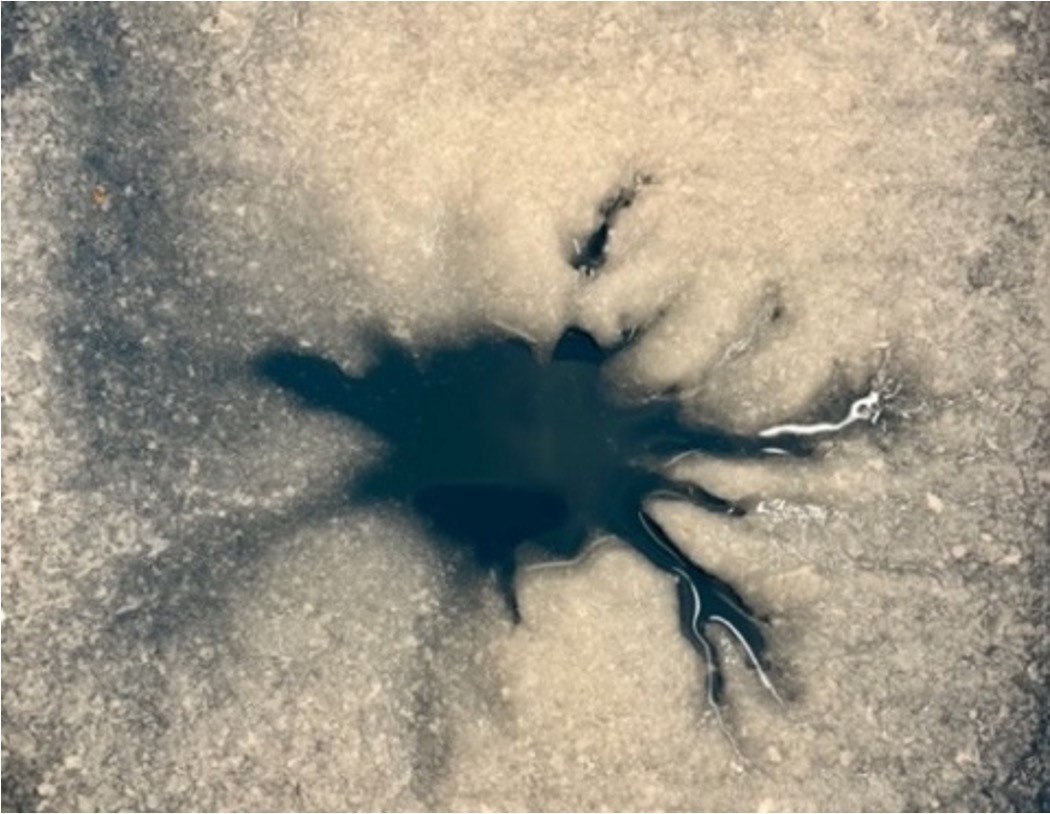
A dendritic `star-like’ pattern formed in the Europa granular ice simulant when water flowed through it under cold simulated post-impact conditions in the lab (PC: Lauren Mc Keown).
geomorphology research help us understand how volatile‑driven processes operate under extreme conditions. When active gullies and Recurring Slope Linae were found on Martian slopes for example, connection with similar features formed on Earth by liquid water-assisted debris flow posed a problem – how could water flow at the low pressures and temperatures of present-day Mars? Theoretically, this was not possible, except for at limited ranges. So followed an advent of experimental work investigating how exactly liquid water behaves under limited circumstances on Mars today and colleagues discovered all sorts of weird and wonderful phase change dynamics such as levitating water pellets (Raack et al., 2017), that actually have vast geomorphic agency under low pressure regimes. Since then, similar insights have been gained via analog lab experiments I was fortunate to be involved with investigating gullies on small bodies (Poston et al., 2024) – we found that even under post-impact far lower pressure conditions than on Mars, water could exist as liquid for up to an hour! Further experimental work that I led regarding a potentially liquid-water driven star-like feature on Europa (Mc Keown et al., 2025) explored the role of transient brine activity under extremely low temperature conditions, finding the spread of water through slush can melt dendritic patterns similar to Earth’s lake stars. That brings me full-circle to Earth and the importance of analog field geomorphology in understanding how granular materials and seasonal frosts interact on Mars and other planetary surfaces – a whole host of research has benefited from our knowledge of cold‑climate landforms and highlights fundamental geomorphic principles that apply across environments, despite different driving boundary conditions; from periglacial terrain like polygonal patterned ground, to gullies, to lake stars on Earth’s frozen lakes and ponds, comparative planetology is a fascinating approach that helps us understand icy surfaces in our solar system much better.