The Geoscience Instrumentation and Data Systems (GI) and Planetary and Solar System Sciences (PS) Divisions of the EGU are excited to host the first joint campfire event, shifting our gaze upward and outward. On Monday, 26 January at 4 pm CET, we invite the geoscience community to a session dedicated to the frontiers of space with the campfire entitled “Investigation of Planetary Bodies: Analog Studies and Mission Concepts”.
Campfires are more than just a series of slides; they are virtual gatherings designed to spark curiosity, facilitate networking, and bridge the gap between different scientific disciplines. This upcoming session explores a fascinating duality in planetary science: how we use our own planet to decode others, and how we dream up the massive engineering feats required to reach the “ice giants” at the edge of our Solar System.
Why Planetary Exploration Matters Now
For centuries, the planets were just points of light. Today, they are complex worlds that hold the secrets to our own origin. By studying planetary bodies, we learn about habitability, the evolution of atmospheres, and the physical laws that govern the universe. However, exploring space is hard. It requires a balance of ground-truth research (using Earth as a laboratory) and bold mission design (building the ships that will take us there).
This Campfire brings together scholars and researchers working on these two pillars: the laboratory-driven study of Earth analogs and the visionary planning of future deep-space missions.
Speakers Information
Aurélie Van den Neucker, PhD Candidate at the German Aerospace Center (DLR)
Talk Title: Neptune Orbital Survey and TRiton Orbiter MissiOn (NOSTROMO): A Mission Concept to Explore the Neptune-Triton System.
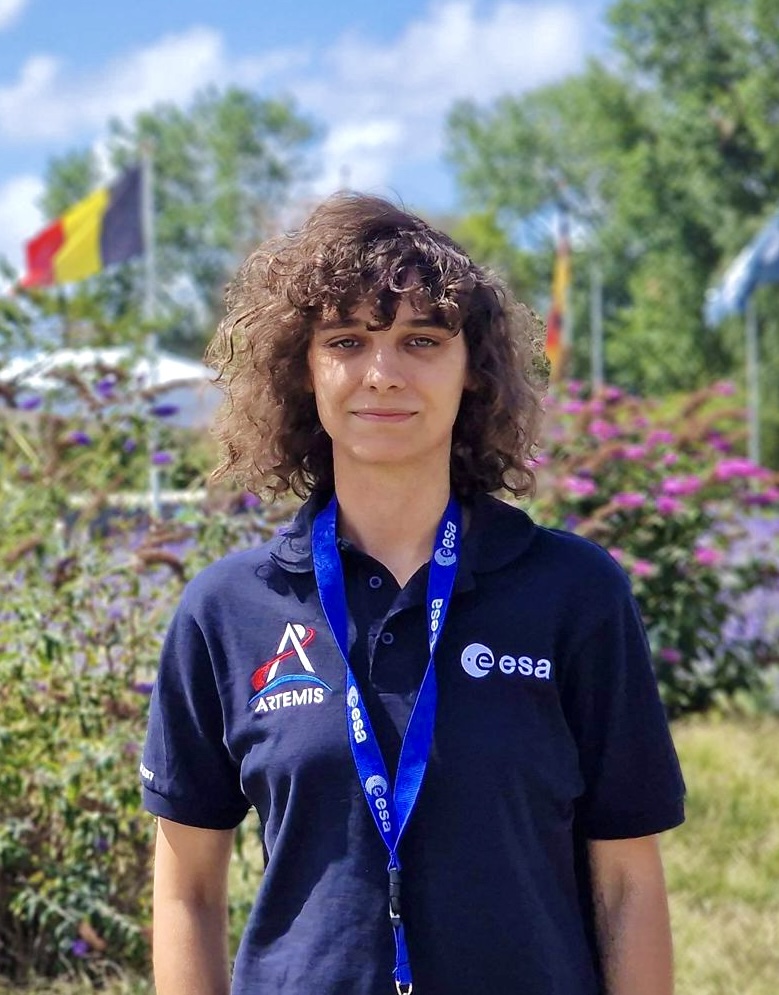
Aurélie‘s research focuses on gaining a better understanding of the composition and physical properties of planetary bodies’ surfaces (Mercury, Ryugu, and Venus). Her background is in planetary sciences and spectroscopy. She is a “lab-person”, and her work includes mostly using in-situ laboratory (spectral) measurements in comparison with orbital surface data.
She is involved in two planetary missions: the BepiColombo to Mercury, the EnVision to Venus.
She is also actively involved in the planetary science community, as Co-Chair of the Europlanet Early Career Scientists (EPEC) network at EPSC(-DPS), and as Co-Chair of the Surface and Environment Interaction Studies (SEIS) YSSG subgroup for the BepiColombo mission.
Beyond her research, she is also interested in the broader aspects of space missions, particularly their coordination and management. She enjoys diving, climbing, travelling, and reading comics.
In her talk, Aurélie will take us to the outer reaches of the Solar System to discuss a mission concept “NOSTROMO”. While Mars and the Moon get a lot of attention, the Neptune-Triton system remains a mystery. NOSTROMO is a mission concept designed to answer big questions: How did an “ice giant” like Neptune form? Could its moon, Triton, hide an ocean beneath its icy crust? As a mission concept targeting a largely unexplored world, NOSTROMO aims to encourage discussion on what the next generation of space missions to distant outer-planet systems could look like.
“I think we should prioritize exploring lesser-known worlds. By focusing on unexplored or poorly explored planetary bodies, we can discover new phenomena and improve our overall understanding of the Solar System”, Aurélie says.
Dr. Enrico Bruschini, Research Fellow at INAF/IAPS
Talk Title: A trip to Terrestrial Analog Sites: Using the Earth to Understand Other Planets.

Dr. Enrico Bruschini’s scientific journey began deep inside the Earth, studying the physics of minerals. Today, he looks at the surfaces of other worlds. His work involves characterizing minerals and organic materials in the lab to make sure we get the most out of the data collected by space missions.
He is currently a member of the ExoMars mission team, where he works on the operation and development of the Ma_MISS instrument.
Enrico is a firm believer that before we look for life elsewhere, we have a duty to protect life on our own planet. When he isn’t in the laboratory, he enjoys being out in nature.
In this Campfire, Enrico will introduce the concept of Planetary Analogs. Since we cannot always send humans or robots to every corner of the Solar System, we find places on Earth—volcanoes, deserts, lakes, etc.—that mimic the conditions of Mars or the Moon. He will explain how by studying the Earth we can understand other planets. It is a story of strengths and limitations, showing that the key to space exploration often starts right beneath our feet.
“It is necessary to explore other bodies, but also to explore new methodologies between disciplines to truly understand the data we collect”, says Enrico.
Looking to the Future
The work of Aurélie and Enrico shows us that planetary exploration is a cycle. We use Earth to learn how to look (Analogs), and then we build the tools to go and see (Mission Concepts). Whether it’s the subsurface oceans of Triton or the dusty plains of Mars, the goal remains the same: expanding human knowledge.
This event will conclude with a Q&A session, offering a unique chance for students, researchers, and space enthusiasts to ask about the challenges of mission design or the future of planetary science.
Event Details
- When: Monday, 26 January 2026 – 16:00 CET.
- Where: Online Zoom, registration is required at https://us02web.zoom.us/meeting/register/HCrtc25dQ1eMVUK7JBFZuA.
- Who: Open to everyone.